
Place
The
Winery
Located in the Loire Valley, the prestigious appellation Chinon owns 2500 hectares of Cabernet Franc grapes. Cravant les Coteaus is a French village that includes 750 hectares of this appellation, but only 70 hectares are located in the hillside. Domaine de Pallus has 12 out of the 70 hectares considered as grand cru. From 2005 Bertrand Sourdais, the fifth generation of the Domaine of Pallus winegrowers, works to show the charm and the historical heritage of the Cabernet Franc in his wines.
Our history
Heritage & history
1882
Josep Moron, the great-great-grandfather leased Domaine de Pallus
1889
Joseph Moron purchased Domained de Pallus
1919
Joseph deceased and J. Sigonneau leased Domaine


1950
Clémentine Moron, Joseph Moron´s daughter and Sourdais’s wife got back to work in Domaine
1959
Clémentine deceased and Raoul Sourdais, his son ran Domaine
1960
A project to improve Domaine. A new well was built and the workhorse was replaced by the first tractor
1965
Raoul Sourdais deceased and his son, Jean –Bernard Sourdais, Bertrand´s father ran Domaine
1969
First bottling in Domaine


1991-1997
Bertrand studied “Viticulture and Oenology”
2005
Bertrand Sourdais ran Domaine
2009
Domaine completely grows using organic viticulture
2013
Revolution in the Pensées de Pallus and in land parceling of winemaking
2015
First vintage of the grand cru, “La Rougerie” and “La Croix Boissée”
2021
Arrival of Martin Sourdais, brother of Bertrand and his wife Pauline who leave the bakery trade to return to the Domaine de Pallus

the data
Data of winery
Region
Loire Valley
Altitude
63m
longitude
47° 15' 4.21"
Latitude
36° 75' 78.3160"
Variety
Cabernet Franc
Climate
Atlantic

Relation between the terroir
and the grand cru in Domaine de Pallus
Domaine de Pallus enjoys a unique situation in the appellation Chinon. In fact, it is surrounded by vineyards in the middle slope considered as the best part in the appellation.
The
Terroir
Terroir in the wine world means the backbone of the soil. We must respect the richness and the diversity of the terroir so as to identify the morphology in our wines.
In Domaine de Pallus we decided to start working our soils in an ecological way not only because we must respect our ecosystem but also because we consider that working the soil in this way is the best choice to carry out the genetics of our soils into our grapes.
Throughout biodynamic, Bertrand Sourdais takes care of his terroir with natural treatments such as the 500 treatment and his own compost.


AOC Chinon
0
HA

Cravant les Coteaux
0
HA

On slopes
0
HA

domaine de pallus 100% on slopes
0
HA
Ecological Agriculture
Sustainability
At Domaine de Pallus we decided in 2009 to start working our lands organically, firstly out of respect for our ecosystem, and secondly because we consider it to be the best way to transmit the genetics of our lands to our grapes.
The Terroir
and the Ecological Agriculture
The soil is the backbone of the expression « terroir » in wine.
We must respect the richness and diversity of the soils to find their morphology in our wines.
At Domaine de Pallus we decided in 2009 to start working our lands organically, firstly out of respect for our ecosystem, and secondly because we consider that it is the best way to transmit the genetics of our lands to our grapes.
As each vintage is different, Domaine de Pallus works its vines depending on the weather conditions. For instance, the works of the green pruning are done earlier and the thinning of the bunches is more severe in a dry vintage.
Every task is decided in real time to preserve the welfare of the vine and to appreciate the small things in each vintage.
Our
Wines
the historical cépage
Cabernet Franc
The cabernet franc comes from the Basque Country, in Spain, from where it was introduced by the pilgrims of the Camino de Santiago on their return from Santiago de Compostela in the villages of Messanges and Cap-Breton (another name for this variety).

Vineyard
2,70 Ha around the domaine
Grape variety
cabernet franc
Soils
sandy, calacareous slopes
Crop
Biodynamic wine growing and hand harvest
Vineyard
from Cravant les Coteaux
Grape variety
cabernet franc
Plot of land
Terrace in the middle of the slope in Pallus
Soil
Sand with rocks rich in iron over calcareous

The revolution of a great classic
Les Pensées de Pallus
Cravant Les Coteaux, proud of its outstanding terroir, of its ideally exposed hill and its old vines inherited from an ancestral heritage, is the jewel of the Chinon wines.
Les Pensées de Pallus comes from the best vines of this terroir and has always been the finest cru among the wines of Chinon
the most familiar plot
Le Clos de Pallus
Le Clos de Pallus monopole de Domaine de Pallus is the most familiar plot of the estate, as we all cross it every day to reach the winery.
With southeast exposure, it is part of the earliest vineyards of the domaine and is, in a way, our reference in terms of cabernet franc.

Vineyard
Cravant les Coteaux
Grape variety
cabernet franc
Plot of land
1.97 ha planted in two times in 1962 to 5000 vines/ha.
Terroir: siliceous clay over calcareous rock
Crop
Biodynamic wine growing
Vineyard
Cravant les Coteaux
Grape variety
cabernet franc (selection masal)
Plot of land
0.51 hectare over a steep slope, planted in 1974 south facing
Soil
Sandy clay over calcareous rock

The Intensity of the “big brother”
La Croix Boissée
La Croix Boissée is a unique plot. Old vines planted in 1974, located on the best slope of the Cravant hill and with an ideal exposure, the very south of the hill. It is a true treasure for the wines in Chinon.
The Grand Cru
La Rougerie
The plot of land of La Rougerie is set in the top part of the property on a gentle slope facing southwards. Besides, this ideal geographic position, the vines grow on a pure clay stain which gives the cabernet franc all its grandeur in a mystic, deep and fascinating nose. A velvety texture with classic tannins and a never-ending finish in mouth make La Rougerie feel the king in Pallus.

Vineyard
Cravant les Coteaux
Grape variety
cabernet franc
Plot of land
Half hectare planted in two stages in 1952 and 2007
Soil
Pure clay
Production
3,000 bottles
Winemaking
Whole-cluster pressing and direct racking into used barrels for a 3-month fermentation.
Soil
Limestone hillsides, southern exposure
Crop
Biodynamic and manual harvest
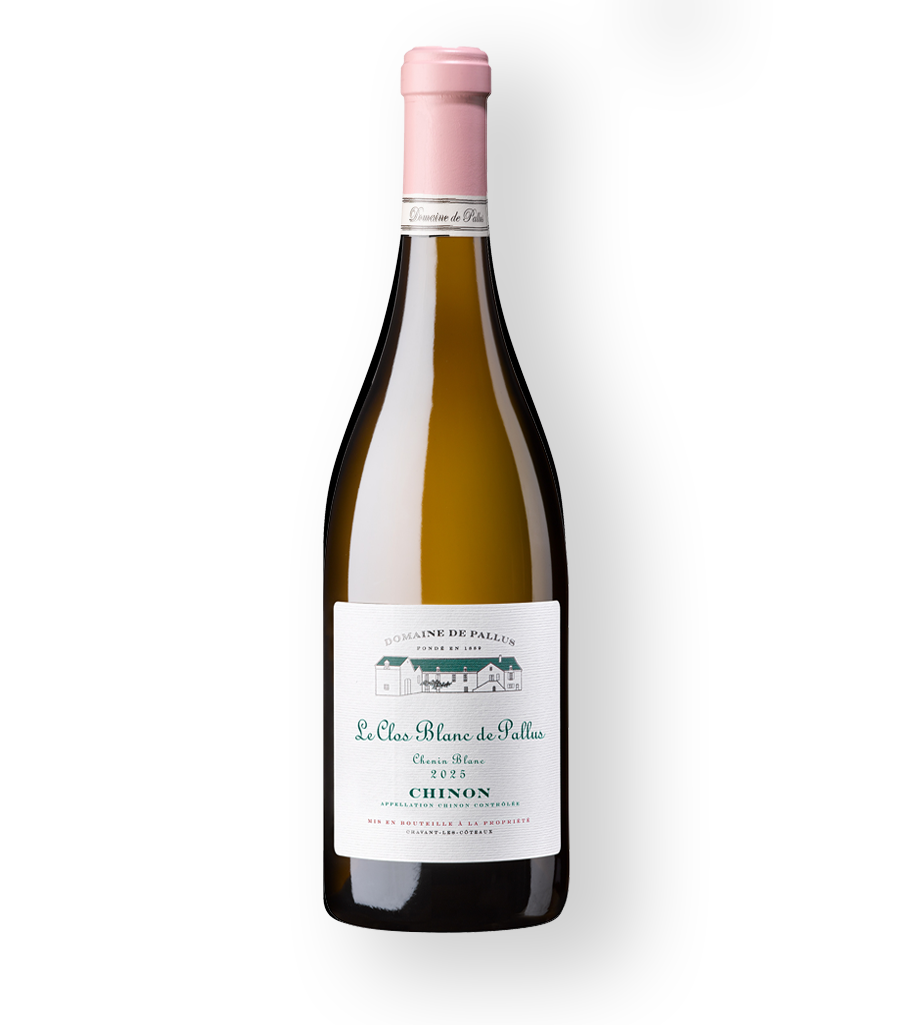
Exceptional grape variety
Le Clos Blanc de Pallus
In the lineage of the finest white wines of the Loire Valley, Clos Blanc de Pallus confirms Chinon’s place among the great terroirs for Chenin Blanc. This cuvée magnifies this exceptional grape variety, revealed here through a finely chiseled, limestone-driven expression.
Production
600 bottles
Winemaking
Whole-cluster pressing and direct racking into new barrels for a 3-month fermentation.
Soil
White clay
Crop
Biodynamic and manual harvest
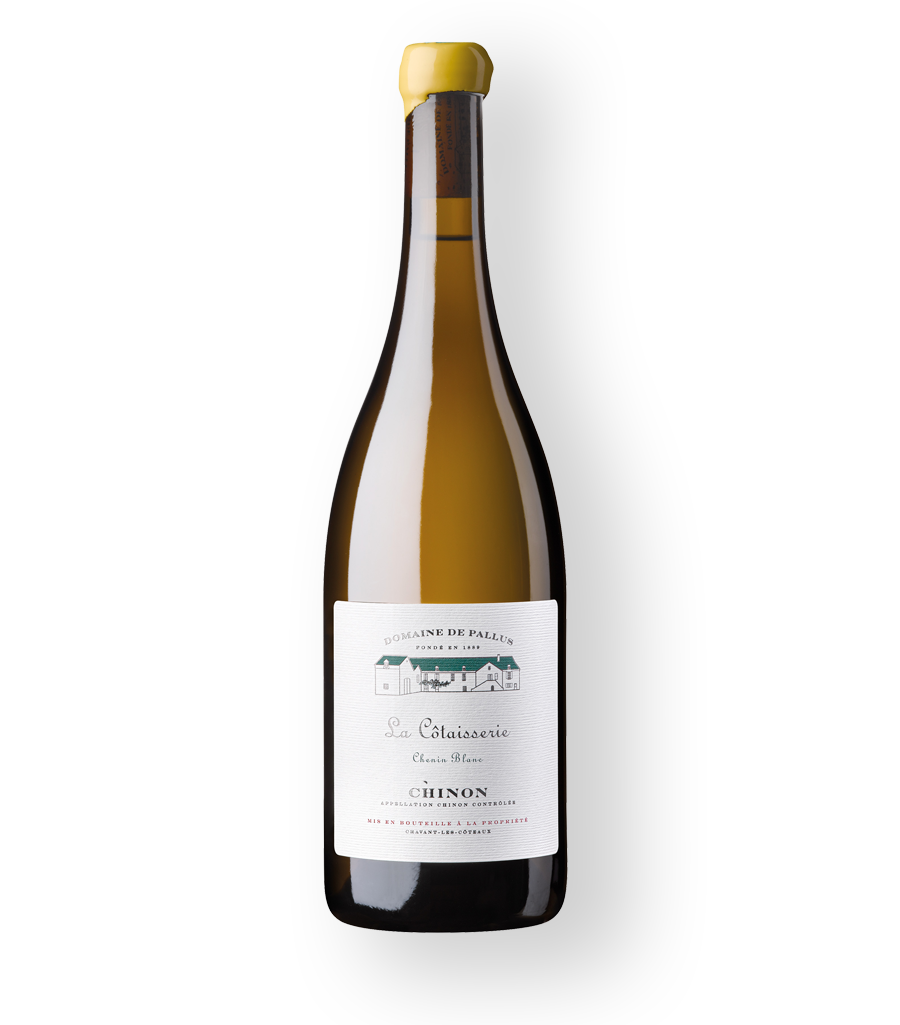
An exclusive
La Côtaisserie
An exclusive, limited-production cuvée from the estate, born from a white clay soil exceptionally rare in Chinon. This unique terroir gives rise to a wine with a silky texture and vibrant minerality—the most intimate expression of our pursuit of elegance and precision
El Cabernet Franc
The historical diversity of the Loire Valley was carried by the pilgrims when they came back from Santiago de Compostela, Spain many centuries ago. The Cabernet Franc has found its perfect terroir to develop in Cravant les Coteaux.
Its subtle aromas of red fruit and soft tannins contribute to its recognized prestige.
In Domaine de Pallus we make an effort to keep and preserve all the genuineness and great qualities of this unique wine variety.
Chenin blanc
Chenin Blanc is a very rare variety, almost a rarity. It represents only 2% of the entire vineyard area in the AOC and is hard to find outside of it, except in newly planted vineyards in recent years. It is a very versatile variety that works well in all categories, which is why it can be found in great sparkling, dry, semi-dry, and sweet wines. It reigns supreme in the Loire Valley and is responsible for the most renowned white wines of the region: Vouvray and Saumur. It’s no coincidence that another name by which it’s known is “Pineau de la Loire.”
The reputation of the great white wines from the Loire -Vouvray and Saumur- is well deserved. Its favored terroir consists of clay and limestone, as is the case with all the great white wines of the world. This is likely why it is not found in many places, as there are not many of these grand cru soils in other regions. At Domaine de Pallus, we have this type of terroir, which has historically allowed us to enjoy Chenin Blanc: family vineyards once existed in Le Petit Carré (a plot located above La Rougerie) and in the upper part of La Croix Boisée.
Vintages
A Year Out of Sync
A standard winter. January was typical, cool with light rainfall until March. Budbreak at Pallus was recorded on April 2. The frost on April 4 only affected young plantings and had no impact on the rest of the estate. From April to May, temperatures were spring-like but with little water. From May 22 to June 7, the climate was relatively warm and remained dry without morning dew.
Flowering took place from May 29 to June 9. A warm, rainy spell began on June 11, creating ideal conditions for downy mildew, which struck suddenly on June 19. July continued with a gloomy summer: rain, clouds, and temperatures fluctuating between 15°C and 26°C until mid-August. It felt as though spring had arrived two months late.
The onset of veraison was noted on July 28. In mid-August, summer weather finally returned, lasting until September 10 when rain returned. Harvesting began on September 20 and concluded on October 2.
2023 is a cool and rainy vintage. Like in 2022, the vines at Domaine de Pallus successfully extracted the best from difficult conditions, yielding fresh, vibrant, dynamic, and perfectly balanced wines with alcohol levels between 12% and 12.5%.
Production:
– “Les Pensées de Pallus”: 17,600 bottles
– “La Rougerie”: 2,631 bottles
– “La Croix Boissée”: 852 bottles
– “Le Clos de Pallus”: 5,972 bottles
– “La Cotaisserie”: 257 bottles
– “Le Coq de Pallus Blanc”: 792 bottles
– “Cabernet Franc”: 14,966 bottles
An Extraordinary Year
January was relatively cold with some rain in Pallus. February remained cold but dry, while March continued with sunny and dry weather. A Saharan dust cloud was observed on March 12 and 13. Budbreak was noted on March 19, which is early.
On April 9, a frost episode affected the vines again, impacting 20% of the yield. The rest of the month remained beautiful and dry. May followed the same pattern, with hot and dry weather and temperatures exceeding 30°C as early as the 10th. Flowering was observed on May 18, extremely early.
June remained very hot. We recorded 15 mm of rain on June 6. By June 14, the grass at Pallus was already dry, creating a landscape reminiscent of August. The first heatwave arrived in mid-June (35-40°C). Cluster closure was observed on July 8. The beginning of veraison was noted on July 27.
In August, the berry size remained small. The vine shoots turned brown, indicating a very early lignification (aoûtement) from the beginning of the month. Only 11.5 mm of rain was recorded on August 16. In early September, a rainy spell finally brought 50 mm of water, allowing the vines to rehydrate and the grapes to swell.
Harvest began on September 9 and ended on the 27th. The vintage surprises with its structure, maintaining reasonable alcohol levels (13-13.5%), good acidity, and a rare tannic precision.
Production:
– “Les Pensées de Pallus”: 19,033 bottles
– “Le Coq de Pallus Blanc”: 978 bottles
– “La Croix Boissée”: 1,802 bottles
– “Le clos de Pallus”: 8,339 bottles
– “Cabernet Franc”: 12,919 bottles
Low Yields, Great Density
January was marked by rain. In early February, the vines began to “bleed” (sap rising), an early phenomenon once again. Spring continued with a cool trend. Budbreak at Pallus was observed on April 1. April was initially dry and warm, with temperatures exceeding 25°C; however, an unexpected frost occurred on April 13.
May saw the return of rain along with cooler temperatures. Flowering began on June 6 and lasted until the 13th. On June 7, a sudden heat spike (30°C) caused a rare simultaneous surge in vine growth and flowering. From June 13, the weather cooled, and a rainy period set in until mid-July.
From mid-July to late August, the summer became hot and dry with low rainfall, leading to a rapid veraison. In September, the return of beneficial—though irregular—rains helped complete the ripening process. Harvesting began on September 28 and ended on October 8. A vintage marked by low yields due to frost, but characterized by significant density and concentration.
Production:
– “Les Pensées de Pallus”: 17,148 bottles
– “La Rougerie”: 2,357 bottles
– “Le Coq de Pallus Blanc”: 242 bottles
– “La Croix Boissée”: 2,140 bottles
– “Le Clos de Pallus”: 6,799 bottles
– “Cabernet Franc”: 7,500 bottles
A Seamless Year
By late January, the vines began to “bleed,” resuming activity as early as the 13th due to abnormally high temperatures. The mild winter triggered an early budbreak on March 21. This warm trend continued until early May. From May onwards, a period of alternating hot and cold weather set in until late June, accompanied by heavy rainfall.
With the vegetative cycle consistently ahead of schedule, flowering began on May 17 and finished on the 30th. July was hot and dry (only 9mm of rain), which slowed the vine’s growth. Veraison began on July 20 but progressed slowly due to the lack of precipitation. From August 14 to 19, 60mm of rain accelerated veraison and revitalized the vines. In September, an autumnal feel settled in, and a late attack of powdery mildew (oidium) was observed on the leaves.
Harvest began on September 11 with the whites. The reds around Pallus were picked between September 14 and 23, initially under intense heat (up to 35°C) followed by 40mm of rain. Despite the early cycle from start to finish, the vines experienced a “fluid” development. The wines display aromatic delicacy characterized by blue fruits and floral notes, with a silky, long palate typical of Cabernet Franc from the slopes.
Production:
– “Les Pensées de Pallus”: 60 barrels (18,000 bottles)
– “La Rougerie”: 6 barrels (1,800 bottles)
– “Le Coq de Pallus Blanc”: 4 barrels (1,200 bottles)
– “La Croix Boissée”: 7 barrels (2,100 bottles)
– “Le Clos de Pallus”: 15 barrels (4,500 bottles)
– “Cabernet Franc”: 6 barrels of 600 liters (4,800 bottles)
The Magic of Years Ending in 9
It’s curious how years ending in 9 -like 1959, 1989, 2019- are part of the legendary vintages.
We started with a rather mild winter, though February brought some cooling, leading to an early budburst on April 1st.
On April 3rd, we recorded -3ºC, which halved the 2019 production. However, given the year’s precocity, the vines did not experience any stress, allowing them to grow using the secondary buds, which, unlike the main buds, only produce a small cluster.
Spring was rather shy with cool temperatures. The vegetation grew slowly as we were under dry conditions.
At the beginning of June, the long-awaited rains arrived, and at the same time, the vines began to bloom (we recorded flowering from June 3rd to 17 th). One of the characteristics of the 2019 vintage is the abundant growth observed from June onwards, despite severe water stress. We can assume that the generosity of the previous vintage contributed to this overall health.
Two temperature peaks marked the summer of 2019, one at the end of June with 42ºC and another at the end of July with temperatures reaching 41ºC. Another characteristic of 2019 is the quality and purity of sunlight; the low relative humidity provided us with crystalline light and very low disease pressure.
By late August, temperatures moderated, and the long-awaited rains arrived in mid-September, helping to smooth out and harmonize ripening. Harvest took place from September 23rd to October 4th. The 2019 vintage imparts precision to the wine (thanks to the light), density (thanks to the frost), and finesse (thanks to the memory of 2018): a legendary vintage.
Generosity!
The winter was marked by abundant snowfall and rain (with 120 mm recorded in January).
Snow, the earth’s lifeblood, helped replenish underground water reserves while also contributing a fraction of nitrogen. This rainy trend continued until mid-July.
Spring was surprisingly mild, with lilies observed blooming on April 21st and swallows returning on April 16th.
Temperatures progressively increased in May and June, with particularly high minimums, creating a “semi-tropical” environment that heightened disease pressure, especially from downy mildew. Special care was needed in the vineyard, yet once again, the vines displayed a good level of self-defense and were barely affected.
From mid-July, temperatures increased and stabilized in August.
August was warm and dry, in contrast to the first half of the year, which was very generous in rain.
September was dry and brought an unusual level of ripeness, with beautiful, fleshy, and dense grapes. The harvest for the whites took place on September 13th, but we decided to wait until September 20th to harvest our Cabernet Franc due to a delayed vegetative cycle.
The Temptress
Winter was soft, mild and with no rain. On 8 March we registered that the grapevine kept on bleeding from January. That meant that the terroir had not been completely cooled down and the vine had not had a deep winter rest period.
April was still good and dry. That meant that the sprout happened very early on 3 April. We observed that the flora around reacted in the same way and the flowering of the lilies of the valley happened on 12 April instead of the 1 May as it used to be.
From 8 to 20 April temperatures dropped from 2ºC to 0ºC nearly reaching the disaster, but the lack of humidity avoided a strong frost. Unfortunately, this situation continued till the frost which provoked the loss of the 15% production on28 April.
The good weather came back and the flowering was early and quick. Maybe the quickest flowering ever seen so far, it only took 7 days with a great aroma intensity. On the contrary, a common flowering needs 15 days.
In June it was very hot registering 38ºC in Domaine de Pallus. This summer heat wave lasted from 15 June to the end of July. The bunches remained small due to this extreme heat. The envero started on 31 July. In August the temperatures were cool and rain made the envero slow down.
In September everything changed with sunny days. The harvest took place between 18 and 19 September thanks to this great end of the season.
The Fighter!
Vintage characterized by the frost on 20 April.
After a timid and mild winter, February and March were cold provoking a delay in the vine. April was mild and the sprout appeared quickly.
Unfortunately, the frost on 27 (above -2ºC) was devastating and it brought back bitter memories from the disaster happened in 1991.
Spring was cool with good rainfall in May. The temperature returned to normal in the middle of June. We noted down the flowering on 15 June.
Summer was good and mainly dry with really low minimum temperatures. We registered 7ºC on 15 July and 6ºC on 11 August.
The envero started on 16 August.
The drought still remained at the beginning of September. However, the rains (36 mm) on 14, 15 and 16 September let the vine find the perfect conditions for the end of the ripening process.
Precision and discretion!
A cold winter with few good days in February and without a common springtime.
We registered little and late grapewine bleeding on 4 March.
The return of the swallows announced a warm and good month on 5 April and the sprout on 14 April.
The beginning of May was warm reaching 30ºC. There was an early flowering. We observed a very early flowering on 31 May.
In the second half of June, it was very cool with the drop in temperature and rain (50mm) on 14 June.
July was very warm and had the effects of the summer heat wave. The vine was able to support well thanks to the rains in June.
By the end of July and during August, the temperatures dropped a lot with temperature minimum of 15ºC during the day and weak rains. This situation made the vine have a rest!
Time for maturity!
Vines grew quickly due to a mild winter in 2014. The sprouts started to swell quite early and the vine sprouted on 30 March.
The beginning of the spring was very dry so there was a delay in the growth of the vine.
By the end of May there was a lot of rain and the flowering happened on 9 June.
Summer was cool and rainy and this situation caused a delay. The ripening started from 11 to 29 August.
After an unstable weather at the beginning of the year, at last the weather was warm and dry at the beginning of September and the ripening of the grapes remained stable.
The whole September was perfect in terms of weather with no rain, sunny days and high average temperatures.
The harvest started on 25 September and finished on 4 October.
Saved from the waters!
It was very rainy and cool in winter in 2013. The rain remained and consequently, it provoked a delay in the vegetative cycle during the spring. At the end of May although it still rained the flowering appeared just in time. This situation proved that the old vines have a solid genetic heritage.
On 17 June, 3 a.m. there was a hailstorm which made the harvest to be divided in two. Rains continued to fall and as a consequence there was an attack of downy mildew in the middle of August. However, once again the vine fought back and resisted well.
The great days at the beginning of September contributed to the right grape ripening.
Where to find us
Address
1 Route de Chinon, 37500
Cravant-les-Côteaux,
France
© All rights reserved Domaine de Pallus. Enjoy our wines responsibly!
Orus Soluciones Design
Domaine de Pallus is proudly powered by WordPress
Esta web utiliza cookies propias para su correcto funcionamiento. Contiene enlaces a sitios web de terceros con políticas de privacidad ajenas que podrás aceptar o no cuando accedas a ellos. Al hacer clic en el botón Aceptar, acepta el uso de estas tecnologías y el procesamiento de tus datos para estos propósitos.
Más información
Privacidad